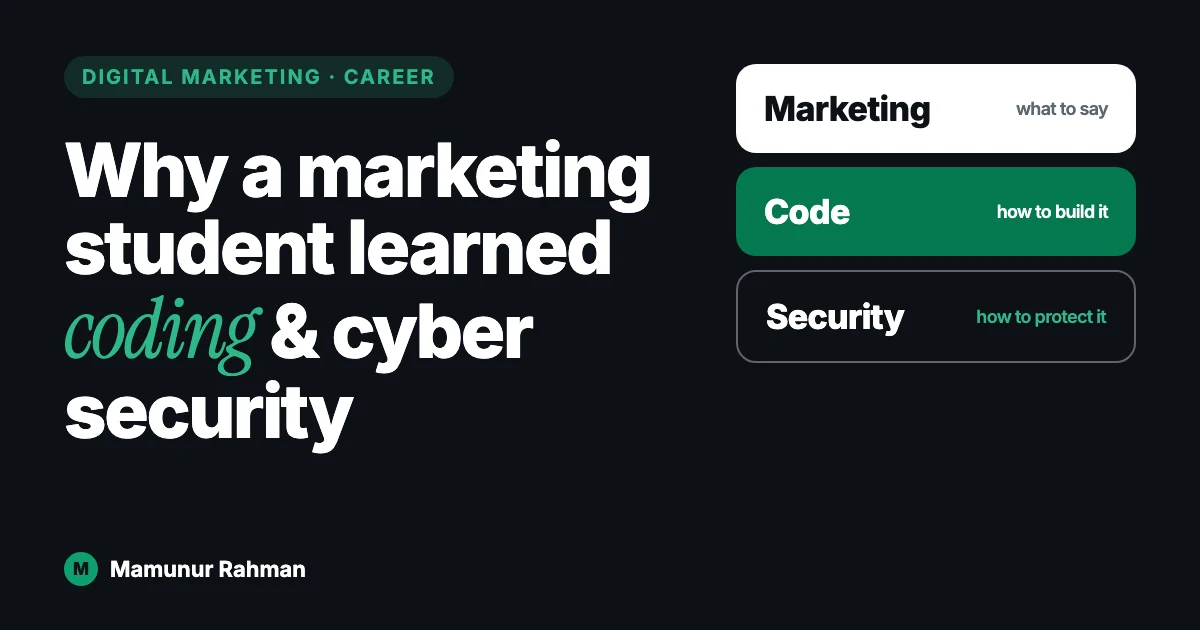
Why marketers should learn coding is a question I asked myself in my second year of a marketing degree. Here is my honest answer: the marketers who get paid the most are not only marketers. They understand how a website is built, and they understand how it can be broken.
Most marketing students study funnels, campaigns, advertising and consumer behaviour. That is what my university teaches, and those things matter. But they are no longer enough on their own.
So I decided to become a complete package. Digital marketing is my main skill. Web development and cyber security are the two skills I am adding around it.
Here is the full story of how I got here, and why I believe every marketing student should think about the same path.
It Started With One Line of SEO Advice
When I began learning SEO, I kept reading the same tip: write a good meta description.
I did not question it at first. I just filled the box in my SEO plugin and moved on. Then one day I asked myself a simple question — where does a meta description actually live?
The answer took me straight into the HTML of my own website:
<meta name="description" content="This is what Google may show under your page title.">That was my first real meta tag. And it opened a door.
I learned that the <title> tag is not the same thing as the heading on the page. I learned that <h1> should appear only once. I learned that alt text on an image is what a search engine and a screen reader both read. I learned that a canonical tag can quietly fix a duplicate content problem that no amount of blog writing will solve.
Suddenly SEO stopped feeling like a checklist. It started feeling like a language. And I could only read half of it.
That was the first moment I wanted to learn code.
Then WordPress Started Saying No
Like most beginners, I built my first websites on WordPress. It was fast, and I did not have to write anything.
But every project ended the same way. I would buy a theme, open the customiser, and find that the one thing I wanted to change was the one thing the theme would not let me change. The button colour was fine. The spacing was fine. But the actual layout? Locked.
So I had three options:
- Accept a design I did not want
- Buy another theme and hope it was more flexible
- Learn to build it myself
The first two options cost money and still ended in a compromise. The third option cost time, but the result belonged to me.
I chose the third one. I enrolled in a web design and development bootcamp and started with the real fundamentals: HTML, CSS, JavaScript, and then modern frameworks.
Today, when a client says “can we move this section above the form?”, my answer is yes. Not “let me ask the developer.”
Why Marketers Should Learn Coding Now: The AI Era Changed the Job
This is the part that convinced me the most.
A few years ago, a small business hired three people: a digital marketer, a web developer, and someone to handle security. Today, many small businesses cannot afford three salaries — and increasingly, they do not need to.
AI has changed the ratio of work to time. Tasks that used to take a full day now take an hour. Writing first drafts, generating variations of ad copy, debugging a piece of code, analysing a spreadsheet of campaign data — AI handles the heavy lifting. What it cannot do is decide what should be built, why it should be built that way, and whether it is safe.
That means the value has moved. It has moved away from doing the task and towards judgement across several fields at once.
So the person a small company wants to hire in 2026 looks like this:
- Someone who can plan the campaign
- Someone who can build the landing page it points to
- Someone who can read the analytics and fix what is broken
- Someone who can make sure the whole thing does not leak customer data
That is one person doing what used to be three jobs — not because they work three times harder, but because AI removed most of the repetitive part.
I want to be that person.
It also makes me better at the marketing part
There is a second benefit that people rarely mention. When you can build the website, you can build the brand properly.
You are not just handing a developer a colour code and hoping. You control the typography, the spacing, the load speed, the mobile experience, the exact position of the call to action. Every one of those things affects conversion rate. Every one of those things is a marketing decision that usually gets made by someone who is not a marketer.
When I build it myself, brand strategy and execution stop being two separate steps.
Why I Added Cyber Security
Web development answered “how do I build it?” Cyber security answers a harder question: “is it safe to trust?”
Every website I build for a client will collect something. An email address on a newsletter form. A phone number on a contact form. A payment on a checkout page. The moment a business collects that data, it takes on a responsibility.
And the risk is not theoretical. Most attacks on small business websites are not clever, targeted hacks. They are automated bots scanning the whole internet for the same handful of weaknesses: an outdated plugin, a weak admin password, a form that does not clean its input, a login page with no rate limit.
The uncomfortable truth is that in digital marketing we spend enormous effort building trust — the brand voice, the reviews, the case studies, the social proof — and a single data breach can destroy all of it in one afternoon.
So I started learning security fundamentals: networking basics, how common web vulnerabilities work (the OWASP Top 10 and MDN’s web security documentation is the standard starting point), how to run a basic security check on a site, and how to fix what I find. I am learning the defensive side and the ethical testing side, so that I can look at a website I built and honestly say what its weak points are.
What this looks like in practice
When I hand over a website now, I am not only handing over a design. I am handing over:
- A site with updated dependencies and no abandoned plugins
- Forms that validate and sanitise what users type
- HTTPS configured properly, not just switched on
- Admin access that is limited and protected
- A backup plan for the day something goes wrong
For a client, that is not a technical detail. That is the difference between keeping their customers and losing them.
What I Am Actually Studying
To be clear, I am not trying to become three separate professionals. I am building one skill set with three layers — what the industry calls a T-shaped marketer: broad knowledge across many areas, with real depth in a few.
This is the practical answer to the question of why marketers should learn coding. Not to change careers, but to make the marketing career work better.
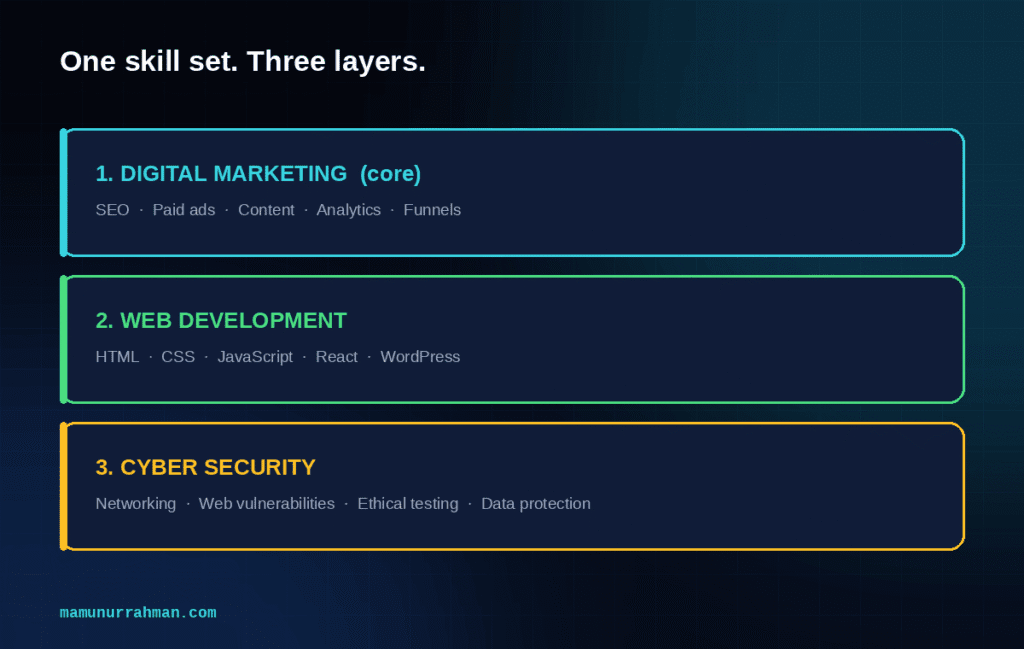
| Layer | What I focus on | Why it matters to marketing |
| Digital marketing (my core) | SEO, paid ads, content, analytics, funnels | This is the business outcome clients pay for |
| Web development | HTML, CSS, JavaScript, React, WordPress beyond themes | I can build and fix the asset the campaign points to |
| Cyber security | Networking, web vulnerabilities, ethical testing, data protection | I can protect the trust the marketing built |
Marketing stays at the centre. The other two make the marketing work better.
What I Would Tell Another Marketing Student
If you are studying marketing right now and most of your modules feel theoretical, you are not imagining it. University gives you the frameworks. It rarely gives you the reps. That gap is the real reason why marketers should learn coding on their own time rather than waiting for a module to teach it.
You have to go and get the reps yourself. Here is what has worked for me:
- Start with the code you already touch. You are already writing meta titles and descriptions. Open the page source and see where they live. That is your first HTML lesson and it is free.
- Build one real thing, not ten tutorials. Build your own portfolio site. Break it. Fix it. That single project will teach you more than a month of watching videos.
- Learn security on your own site first. Run a free vulnerability scan on a site you own. Read what it reports. Fix one issue. Repeat.
- Use AI as a teacher, not a replacement. Ask it to explain the code it gives you, line by line. If you cannot explain it back, you have not learned it.
- Publish what you learn. Writing this post forced me to organise my own thinking. It also happens to be good marketing.
You do not need to be the best developer in the room or the best security researcher in the room. You need to be the marketer who is not afraid of either. That, in one sentence, is why marketers should learn coding.
Where I Am Going Next
This blog is my public record. I am documenting the whole journey — what I am learning in digital marketing, what I am building in web development, what I am discovering in cyber security, and the real projects I complete along the way.
If you are on a similar path, or you are a business owner who wants a marketer who can also build and secure the thing they are marketing, I would like to hear from you.
Read more posts on the blog or get in touch here.
Frequently Asked Questions
Do marketing students really need to learn coding?
Which programming language should a digital marketer learn first?
Is cyber security useful for a marketer?
Can AI replace digital marketers?
How do I start learning web development as a non-technical student?

Mamunur Rahman
Digital marketer in Kuala Lumpur doing local SEO, Google Business Profile and WordPress websites for Malaysian businesses. Everything published here is tested on my own site first.
More about me