For most Malaysian small businesses, a freelancer or a small agency is a better first step than an employee. A marketing executive on RM4,500 costs about RM7,000 a month once EPF, SOCSO, bonus and tools are added (ZenWeb, 2026). Hire in-house when the work fills 40 or more hours a week in one or two channels.
Three things decide it: how many hours of work you really have, how many different skills it needs, and who will manage the person doing it. Below are the costs, the trade-offs, and a four-question test.
One disclosure first. I’m a freelancer, so I have a side in this. Both price guides I cite below come from agencies that sell these services, so treat their numbers as rough ranges.
The short answer, by situation
| Your situation | Usually the best fit |
|---|---|
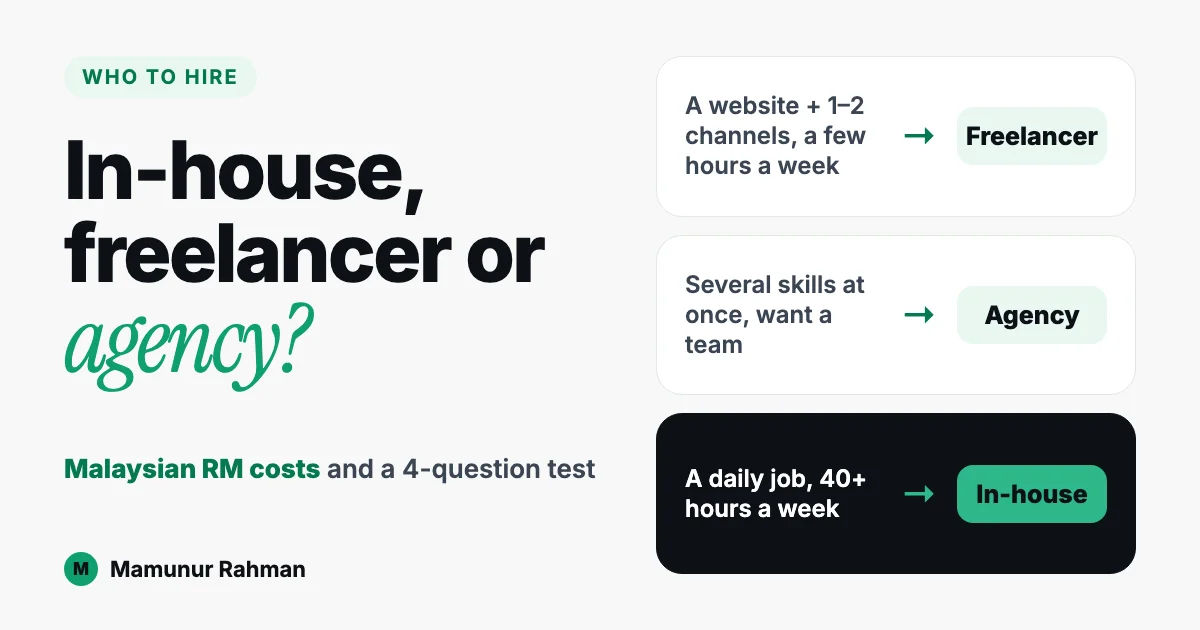
| A website plus one or two channels (for example Google Business Profile), a few hours of work a week | Freelancer |
| Website, SEO, ads and social all at once, and you want a team and regular reports | Agency |
| Marketing is a daily job of 40+ hours a week in one or two channels, and brand knowledge matters | In-house |
| You have a steady need but not a full-time one | A mix (see “The mix most businesses end up with”) |
If your question is only about SEO, read my SEO freelancer vs agency comparison instead. This article covers the wider question of who builds and runs your website and marketing.
What each option costs in Malaysia
These are published ranges from two Malaysian agencies, both dated 2026. They don’t agree with each other because they measure different scopes.
| Option | One-off website | Monthly ongoing |
|---|---|---|
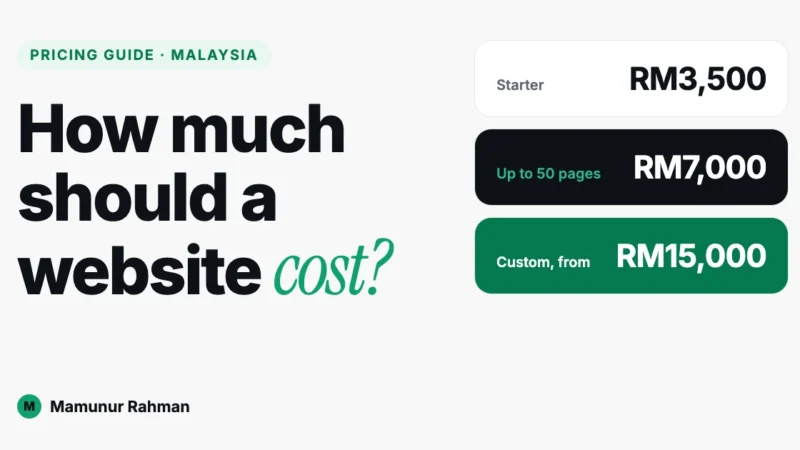
| Freelancer | RM1,500–8,000 for a standard business site | RM200–800 for site maintenance |
| Agency | RM5,000–12,000 entry level; RM12,000–30,000 mid-tier | RM1,500–5,000 retainer, depending on scope (Xwork); RM2,500–8,000 marketing retainer (ZenWeb) |
| In-house employee | none (salary instead) | Web developer salary RM2,800–4,000 junior, RM4,500–7,500 mid-level (Xwork), plus the extras below |
Sources: Xwork’s 2026 web developer cost guide (published 2026-08-17) and ZenWeb’s marketing staff vs agency cost guide (published 2026-06-15).
A freelancer at the top of the range costs about the same as an agency at the bottom, so compare what each quote includes.
The in-house number people forget
The salary is only part of the cost. ZenWeb’s worked example for a marketing executive on RM4,500 a month:
| Item | RM per month |
|---|---|
| Base salary | 4,500 |
| EPF (employer, 13%) | 585 |
| SOCSO + EIS | 88 |
| Bonus (1.5 months a year, spread out) | 563 |
| Tools and software | 450 |
| Equipment and workspace | 350 |
| Training | 200 |
| Hiring cost (spread out) | 250 |
| Total | 6,986 (about RM83,800 a year) |
The employer EPF rate is 13% of salary up to RM5,000 and 12% above that (KWSP). SOCSO and EIS follow PERKESO‘s wage-band table, with a wage ceiling of RM6,000; on RM4,500 they come to about RM87, in line with ZenWeb’s RM88. The tools, equipment and training lines are ZenWeb’s assumptions, and a lean hire may cost less. As a rule of thumb, budget about 1.5 times the salary.
Option 1: In-house
It fits when the work is daily and continuous (ZenWeb’s test is 40+ hours a week in one or two channels), your product or brand needs deep knowledge, you need changes made the same day, and someone in the business can manage the hire.
The catch: one person is rarely a designer, developer, SEO, ad buyer and copywriter at once. And when they resign, the passwords, files and know-how leave with them unless you made them part of the job. A clinic whose website changes a few times a month does not have 40 hours of work. You’d be paying for idle time.
Option 2: Freelancer
It fits when the scope is clear and fairly small: a business website, Google Business Profile, a monthly upkeep routine. You talk to the person doing the work, and a freelancer usually has no office or sales team to pay for.
The catch: there’s one person, so no backup if they’re ill, busy or leave the industry. Xwork calls a solo freelancer “a single point of failure” and rates the continuity risk as high. Every freelancer also has a ceiling on how much they can do well at once. Ask where theirs is.
A protection that costs nothing: make sure the domain, hosting, Google Business Profile, Search Console and Analytics are all registered in your name, with the freelancer added as a user. Switching providers is then a hassle you can manage.
Option 3: Agency
It fits when you need several skills running together, such as website, SEO, ads and content, and you want cover when someone is away. An agency is built for that, and it brings reporting and process.
The catch: you pay for the structure. Often you talk to an account manager and not the person who does the work, so ask who will actually touch your site or account. Check the contract length and what happens to your accounts if you leave.
The mix most businesses end up with
In practice many Malaysian SMEs combine options. A common pattern: a freelancer builds the website and handles monthly upkeep, someone inside the business answers reviews and posts updates, and an agency joins only if ad spend or channel count grows. ZenWeb describes a related setup: one in-house person on strategy and brand, with an agency doing the execution.
A four-question test
- How many hours a week is the work, honestly? Under about 10 hours, a full-time employee rarely makes sense. Around 40 or more in one or two channels, in-house starts to make sense (the 40-hour mark is ZenWeb’s; the lower bound is my rule of thumb).
- How many different skills does it need? One or two, such as a website and Google Business Profile: a freelancer can cover it. Four or more at once: you want a team.
- Who will manage them? Every option needs a person on your side who can say yes, no and “show me.” If nobody has the time, the project manager an agency provides is part of what you’re paying for.
- What happens if they disappear next month? If the answer is “we lose our website login,” fix that before you choose anyone.
A worked example (hypothetical)
Take a dental clinic in Selangor that needs a new website of about eight pages, plus upkeep and a few updates a month. It’s a made-up example, not a client. The arithmetic uses the ranges above for the first year:
- Freelancer: RM1,500–8,000 for the site, plus RM200–800 a month for upkeep (RM2,400–9,600 a year). First year: RM3,900–17,600.
- Agency: RM5,000–12,000 for the site, plus RM1,500–5,000 a month (RM18,000–60,000 a year). First year: RM23,000–72,000. Xwork says the retainer depends on scope, so an agency’s upkeep-only plan may cost less than this.
- In-house junior web developer (Xwork’s RM2,800 salary): EPF 13% is RM364 and SOCSO plus EIS roughly RM55, so about RM3,220 a month, or RM38,600 a year before tools, bonus and training. At the 1.5 times rule of thumb it’s closer to RM50,000. One person would not have a full week of work here either.
For scale, a marketing executive at ZenWeb’s example would be about RM83,800 a year. The ranges are wide, so use them as a guide to which questions to ask. Get at least two quotes with the same written scope, then compare what each includes.
Questions to ask before you sign
- Who registers the domain and hosting, and in whose name?
- What exactly is in the monthly upkeep (updates, backups, security, small content changes), and what is billed extra?
- How many rounds of revisions are included in the website price?
- What do I get in writing at the end (logins, files, documentation)?
- Can you show me work I can check for myself?
That last one matters. As an example of checkable work, I published a study of whether Google reviews affect Maps visibility across 76 dental clinics around Seri Kembangan, Selangor (one scan, run 2026-07-31) as an open article you can read: Do more Google reviews improve local ranking?. You can judge how I work from that, whether or not you ever hire me. Ask anyone you’re considering, freelancer or agency, for something similar.
For questions specific to hiring for SEO, see my freelancer vs agency article for SEO.
FAQ
How much does an in-house marketing executive cost in Malaysia?
Expect about 1.5 times the salary. ZenWeb’s 2026 example puts a RM4,500 salary at roughly RM6,986 a month, or about RM83,800 a year, once EPF, SOCSO, EIS, bonus, tools, equipment, training and hiring costs are counted. The tools and equipment lines are its assumptions, so a lean hire may cost less.
Is a freelancer cheaper than an agency in Malaysia?
Usually for a single project, but not always. Xwork’s 2026 ranges are RM1,500–8,000 for a freelancer-built business site and RM5,000–12,000 for an entry-level agency build, so they overlap. Compare what each quote includes: revisions, maintenance, support and who owns the accounts.
When should a small business move from a freelancer to an agency?
When you need several skills running at once, such as website, SEO, ads and content, or when you can’t risk a gap if one person is unavailable. If one person can still cover the work well and you have direct access to them, there’s no need to move.
Can I use a freelancer and an agency together?
Yes, and many businesses do. A freelancer can look after the website while an agency runs ads, as long as one person on your side keeps the logins and sets the goals so the two don’t work against each other.
Final thoughts
There isn’t one right answer. I’m a freelancer because I think it suits owners who need one or two things done well, and a clinic, homestay or service business often fits that. If your situation is bigger than what one person can cover, an agency will serve you better, and I’d tell you so.
If you’d like to talk it through, WhatsApp me directly and I’ll give you my honest read. You can also see how my website work is packaged, read about web design, or check how much a website should cost in Malaysia.
Written by Mamunur Rahman, a freelancer who builds WordPress websites and helps small businesses in Malaysia with local SEO.

Mamunur Rahman
Digital marketer in Kuala Lumpur doing local SEO, Google Business Profile and WordPress websites for Malaysian businesses. Everything published here is tested on my own site first.
More about me