Quick Answer
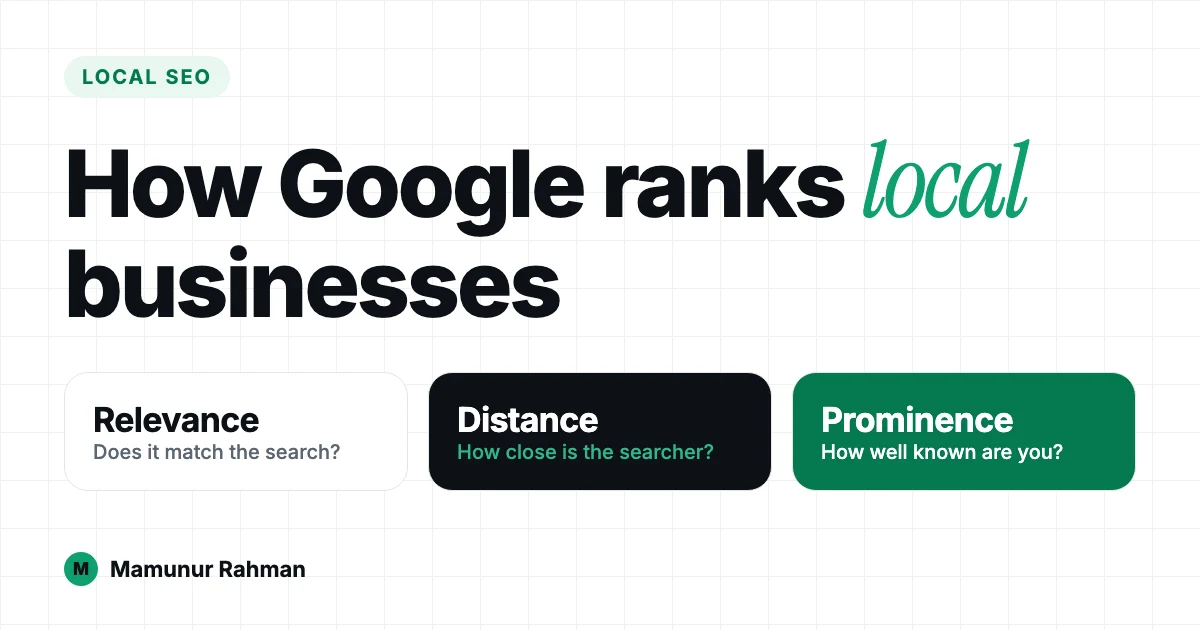
Google ranks local businesses using three official factors: relevance, distance, and prominence. Relevance is how well your business matches the search. Distance is how close you are to the searcher. Prominence is how well-known and trusted your business looks online. You cannot control distance. You can control relevance and prominence — and that is where 100% of your local SEO effort should go.
Introduction
Last week I searched “dentist near me” on my phone in Kuala Lumpur.
Google showed me three clinics in a small box with a map. I did not scroll. I did not compare ten websites. I tapped the first one, looked at the reviews, and called them.
That is how most people choose a local business now. Three results. Ten seconds. Done.
So the real question for every local business owner is simple: how does Google ranks local businesses and decide which three get that box?
I have spent the last few days studying this properly — Google’s own documentation, the 2026 Whitespark ranking factors survey, and real local pack results. In this guide I will explain exactly how Google decides local rankings, in plain English, with no jargon.
By the end you will know:
- The three official factors Google uses (and which two you can actually control)
- Why the Local Pack, Google Maps, AI Overview and organic results are four different competitions
- The one signal that changed the most in 2026 (this surprised me)
- A 7-day action plan you can start today
I am Mamunur Rahman, a Digital Marketing student at Asia Pacific University in Malaysia. I am learning local SEO in public and documenting everything I test. So this is not theory copied from a textbook — it is what I am actually studying and applying.
Let’s start.
What Is Local Ranking? (A 30-Second Explanation)
When someone searches for a business near them, Google does not show normal website results first. It shows a special box called the Local Pack (many people call it the Map Pack).
It looks like this:
📍 Map ★★★★★ 4.8 · ABC Dental Clinic · Bukit Bintang · Open now ★★★★★ 4.7 · Smile Studio KL · Bangsar · Open now ★★★★☆ 4.5 · Bright Dental Care · Mont Kiara · Closes 6 pm
Only three businesses get in.
Below that box, normal websites appear. Above it, Google’s AI Overview may appear. And inside the Google Maps app, the order can be completely different again.
Getting into that three-result box is what local SEO is really about. It is also the fastest way for a small business to get phone calls — no ad budget needed.
How Google Ranks Local Businesses: The 3 Official Factors
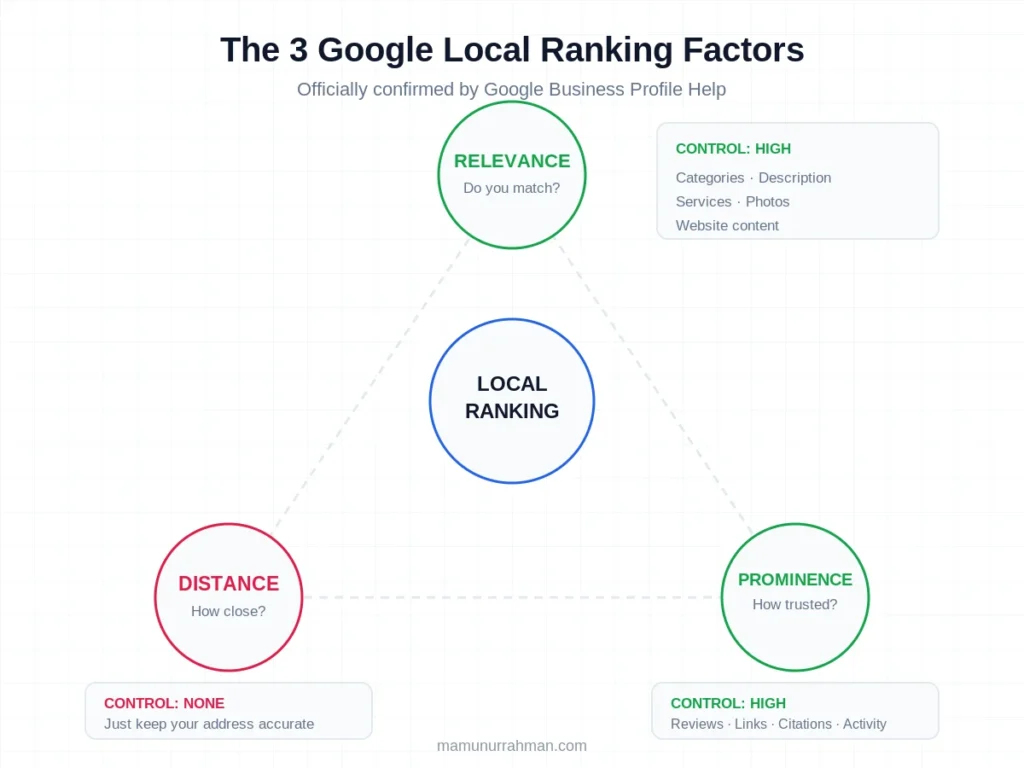
Google has publicly stated in its Business Profile Help documentation that local results are based on three things: relevance, distance, and prominence.
Let me break down each one the way I wish someone had explained it to me.
1. Relevance — “Does this business match what I asked for?”
Relevance is Google asking: is this business actually the thing the person is looking for?
If someone searches “emergency dentist Kuala Lumpur” and your profile says “General Dentist,” you are less relevant than a clinic whose profile clearly says “Emergency Dental Service.”
Google measures relevance using:
| Signal | Why it matters |
| Primary category | The single strongest relevance signal on your profile |
| Secondary categories | Helps you appear for related searches |
| Business description | Tells Google what you actually do |
| Services list | Each service is a chance to match a different search |
| Products | Especially useful for retail and restaurants |
| Website content | Google reads your site to confirm what you offer |
| Profile completeness | Empty fields = missing information = weaker match |
| Photos | Google’s AI reads images to understand your business |
| Keywords inside reviews | When customers write “teeth whitening,” that is a relevance signal |
The mistake I see everywhere: business owners choose a vague primary category like “Business Service” or “Store.” That is like introducing yourself at a networking event as “a person.” Be specific.
What to do today: Open your Google Business Profile. Check your primary category. Make sure it matches your highest-value service exactly.
2. Distance — “How close is this business to me?”
Distance is how far your business is from the searcher. If the searcher does not mention a location, Google uses their GPS or IP address.
This is the factor you cannot control. You cannot move your shop closer to every customer.
But you can avoid damaging yourself:
- ✅ Use your real, verified physical address
- ✅ Set accurate service areas if you travel to customers
- ✅ Keep your address format identical everywhere online
- ❌ Never create fake locations or use a virtual office you don’t work from — Google suspends profiles for this, and recovering is painful
Important truth that gives me hope: distance matters a lot, but it is not everything. A business 4 km away can outrank a business 1 km away if its prominence signals are much stronger. You cannot beat distance. You can beat everyone on relevance and prominence.
3. Prominence — “How famous and trusted is this business?”
Prominence is Google asking: does the real world seem to like and trust this business?
This is the biggest area of opportunity, and it is built from many signals stacked together.
Reviews
- Total number of reviews
- Average star rating
- Review quality and length
- Review freshness (huge in 2026 — more on this below)
- Keywords customers naturally use in reviews
- Whether the owner replies
Backlinks
If trusted websites link to you, Google trusts you more. For a local business, the most valuable links come from:
- Local newspapers and news sites
- Universities and colleges
- Chamber of commerce and business associations
- Industry directories
- Local bloggers and event pages
- Suppliers and partners
Citations (NAP consistency)
NAP = Name, Address, Phone.
Google compares your NAP across hundreds of websites. If everything matches perfectly, Google gains confidence. If your phone number is different on three directories, Google gets confused — and confusion costs you rankings.
Note: in 2026, citations are worth less than they used to be (around 7% of local pack weight according to the Whitespark survey). They are still worth fixing, but do not spend all your time on them.
Website authority
Your Google Business Profile does not exist alone. Google also looks at your website:
- Content quality and depth
- On-page SEO
- Internal linking
- Backlinks
- Technical SEO and page speed
Profile activity
Google favours businesses that look alive. Signals include:
- Weekly Google posts
- New photos uploaded regularly
- Updated opening hours (especially holidays)
- Replying to reviews
- Adding new services
- Answering Q&A
Behavioural signals
Google watches how people react to your listing:
- Click-through rate
- Phone calls from the listing
- Direction requests
- Website clicks
- Photo views
- Time spent on your profile
If people consistently choose you, Google learns you are the better answer.
The Local Ranking Formula
Here is how I now think about it in my head:
According to the 2026 Whitespark Local Search Ranking Factors survey, the approximate weight of each signal group for the Local Pack is:
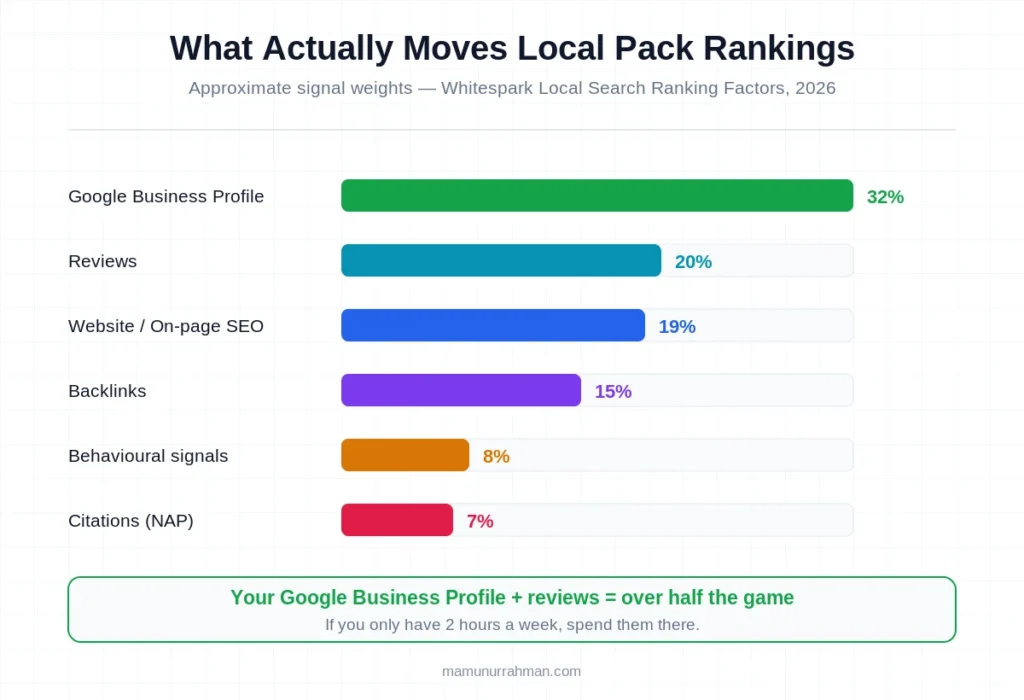
Look at the top two rows. Your Google Business Profile and your reviews are more than half of the game. If you only have two hours a week for local SEO, spend it there.
The 4 Local Battlegrounds (Most Guides Skip This)
This is the part that changed how I think about local SEO.
When you search on Google, you are not competing in one race. You are competing in four different competitions, each with a different judge.
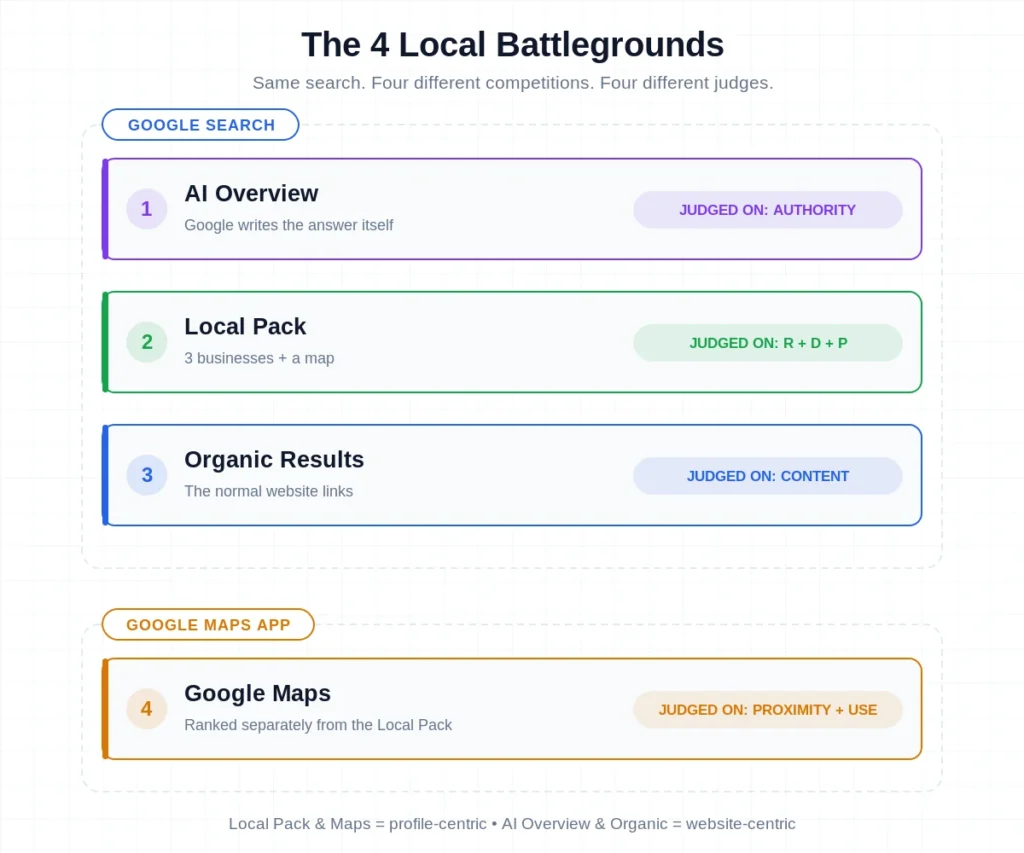
They are connected, but they do not use the same ranking system. Here is what each one actually rewards.
1. AI Overview
Google’s AI writes a direct answer instead of listing links. For a search like “best Invisalign provider in Kuala Lumpur,” it may generate a short summary and cite a few sources.
What it rewards: deep, genuinely helpful website content, topical authority, brand reputation, trusted backlinks, accurate business information, structured data (schema), and clear demonstration of Experience, Expertise, Authoritativeness and Trustworthiness (E-E-A-T).
Google is asking: Which sources can I trust enough to quote?
2. Local Pack
The three-business box with the map.
What it rewards: relevance, distance, prominence — plus profile optimisation, review quality and freshness, correct categories, photos, local backlinks, NAP consistency, and engagement.
Google is asking: Which three businesses are the best match for this local search?
3. Google Maps
Many people assume Maps and the Local Pack are the same. They are not.
A business can rank #1 in Maps and not appear in the Local Pack at all — and the reverse happens too.
Maps leans much harder on proximity and real-world behaviour: direction requests, navigation, actual visits, popular times, calls from Maps, photo views, review activity, and profile completeness.
Google is asking: If someone is navigating right now, which places nearby are most useful?
4. Organic Results
The normal website links below the Local Pack.
What it rewards: content quality, search intent match, backlinks, technical SEO, page speed, mobile friendliness, internal linking, topical authority, structured data, and user experience.
Google is asking: Which webpage best answers this search?
The key difference: the Local Pack and Maps are profile-centric. Organic and AI Overview are website-centric. That is why a business with a perfect Google Business Profile but a weak website wins the map box and loses everywhere else.
| Battleground | Main goal | Strongest signals |
|---|---|---|
| AI Overview | Generate a trustworthy answer | Content quality, topical authority, E-E-A-T, backlinks, brand reputation, schema |
| Local Pack | Recommend the best nearby businesses | Relevance, distance, prominence, reviews, GBP optimisation |
| Google Maps | Help people find and reach a place | Proximity, engagement, profile activity, reviews, real-world popularity |
| Organic | Rank the best webpages | Content, backlinks, technical SEO, intent match, UX |
My takeaway: stop asking “how do I rank on Google?” Start asking “which of the four do I want to win first?” For most local businesses, the answer is the Local Pack — it produces phone calls fastest.
The 2026 Shift: Review Recency Now Beats Review Count
This was the most surprising thing I learned.
For years, the advice was simple: get as many reviews as possible. Review count was king.
In 2026, that changed. Fresh reviews now matter more than total reviews.
Look at this comparison:
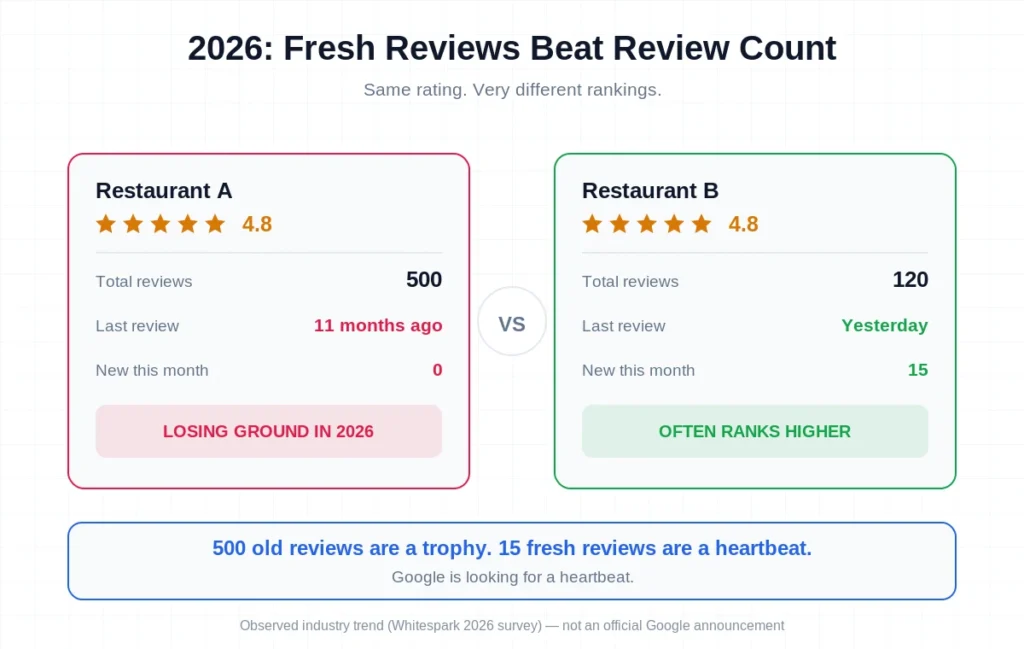
In 2022–2024, Restaurant A usually won because of its review count.
In 2026, Restaurant B often outranks Restaurant A. Google sees ongoing customer activity, not just historical popularity.
The data backs this up. In the Whitespark Local Search Ranking Factors survey, review recency jumped from around #93 in 2023 to #11 in 2026 — reportedly the single largest positional jump in the entire study. Review signals overall grew from roughly 16% to 20% of Local Pack weight.
Be careful here: Google has never officially announced “we now weight recency more.” This is an observed trend from industry surveys and case studies, not a confirmed algorithm statement. I am telling you what the data suggests, not what Google promised.
But the practical lesson is solid, and it is good business anyway:
500 old reviews are a trophy. 15 fresh reviews are a heartbeat. Google is looking for a heartbeat.
What this means for you
Stop running one big review campaign per year. Build a review system instead:
- Ask every happy customer, every week — not in bursts
- Aim for a steady trickle (even 2–4 per month beats 40 once a year)
- Send the ask within 24 hours of a good experience, when the feeling is fresh
- Make it one tap — use your Google review short link
- Reply to every review within 48 hours, positive or negative
- Never buy reviews or offer discounts for them — it violates Google’s policies and can get your profile suspended
Consistency beats volume. That is the whole 2026 lesson in one sentence.
The 7-Day Local SEO Action Plan
Reading is not ranking. Here is exactly what I would do in the first week, in order.
Day 1 — Fix relevance Set the correct primary category. Add 3–5 relevant secondary categories. Rewrite your business description in plain language, mentioning your main service and city naturally.
Day 2 — Complete the profile Fill every single field: hours, holiday hours, phone, website, attributes, opening date, service areas. Empty fields are lost points.
Day 3 — Add real photos Upload 10–15 genuine photos: exterior, interior, team, products, work in progress. Real photos beat stock photos every time, and Google’s AI reads them.
Day 4 — List your services Add every service as a separate entry with its own short description. Each one is a new door for a different search.
Day 5 — Audit your NAP Search your business name in Google. Check the top 20 places you appear. Make Name, Address and Phone identical everywhere. Fix the mismatches.
Day 6 — Build the review system Create your Google review short link. Write a short, polite request message. Set a weekly reminder to ask recent customers. Reply to every review currently sitting unanswered.
Day 7 — Start the activity habit Publish your first Google post. Then commit to one post and 2–3 new photos every week. Google rewards businesses that look alive.
Do this for 90 days and you will out-work almost every local competitor in your area. Most of them do nothing after the first week.
If you’d rather have someone else run this week for you, that’s exactly what my local SEO service covers.
5 Mistakes That Quietly Kill Local Rankings
- Keyword stuffing your business name. “Best Cheap Dentist KL Bukit Bintang” is a policy violation. Use your real name.
- Inconsistent NAP. Three phone numbers across the web tells Google you might not be a real, stable business.
- Fake or virtual addresses. Short-term gain, long-term suspension.
- Ignoring negative reviews. A calm, professional reply often impresses future customers more than a perfect score does.
- Setting it and forgetting it. A profile that has not been touched in a year looks closed to Google.
How long does local SEO take to show results?
Can I rank without a physical address?
How many reviews do I need to rank in the Local Pack?
Does replying to reviews help rankings?
Why do I rank in Google Maps but not in the Local Pack?
Is the Local Pack still important now that AI Overviews exist?
How much does it cost to fix a poor local ranking?
Final Thoughts
Here is the whole article in five lines:
Final Thoughts
Google ranks local businesses using three official factors: relevance, distance, and prominence. You cannot control distance — so stop worrying about it. Your Google Business Profile and reviews are over half the weight. The Local Pack, Maps, AI Overview and organic results are four separate competitions. In 2026, fresh reviews beat old reviews — build a system, not a campaign.
I am learning local SEO in public and publishing everything I test on this blog. Next I am running a real Local Pack audit on a business in Kuala Lumpur and sharing the full results — the wins and the failures.
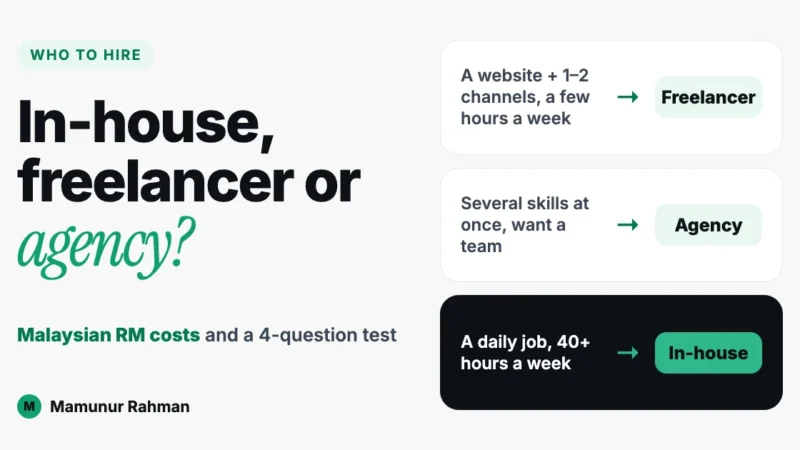
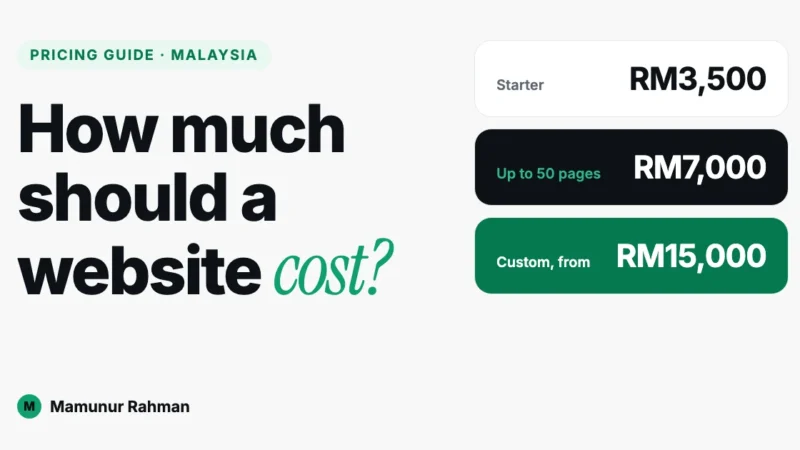
Deciding whether to do this yourself, hire a freelancer, or bring in an agency? I’ve written an honest breakdown of freelancer vs agency for SEO in Malaysia. If you’re also budgeting for a new site, here’s how much a website should cost in Malaysia.
Free Download
The 7-Day Local SEO Checklist
Every task from this guide as a printable tick-box checklist. 6 pages, no fluff.
Download the Checklist (PDF)If you run a local business: tell me your city and your industry in the comments, and I will look at your Local Pack competition and reply with one specific thing you can fix this week.

Mamunur Rahman
Digital marketer in Kuala Lumpur doing local SEO, Google Business Profile and WordPress websites for Malaysian businesses. Everything published here is tested on my own site first.
More about me